Protests took place in Tel Aviv, Jerusalem, Haifa, and Beersheba, as a survey found broad but uneven support among Jewish Israelis for Operation Roaring Lion.
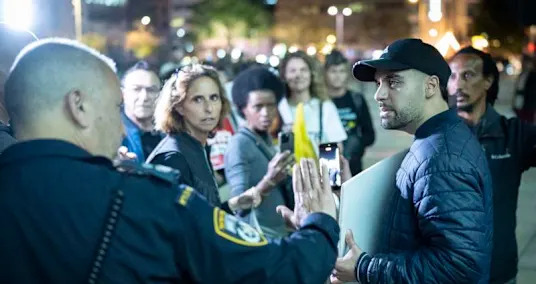
Israel Police arrested 21 anti-war protesters Saturday night as demonstrations against the conflict with Iran expanded in multiple cities despite restrictions on public gatherings.
Protests took place in Tel Aviv, Jerusalem, Haifa, and Beersheba, with hundreds of participants reported in Tel Aviv and Jerusalem and about 100 in Haifa, marking the largest turnout since weekly demonstrations began. Authorities said 13 people were arrested in Tel Aviv and eight in Haifa.
Police said the gatherings were not approved under Home Front Command regulations that ban events with more than 50 people. Officials said the increase in turnout followed calls by groups opposing the government to protest despite the restrictions.
“During a situation assessment that took place at the scene with a Home Front Command representative… it was clarified that there was a real risk to human life and accordingly, Yarkon [precinct] police commander Tzachi Sharabi ordered the gathering to be dispersed,” police said.
Hadash-Ta’al chairman Ayman Odeh, an Arab lawmaker involved in the protests, criticized the police response, calling officers fascists “in the service of the government” and saying they were afraid of “the heroic citizens who went out, despite everything, to make their voice heard.”

Survey shows broad, uneven support for war
The demonstrations come as a March 2026 survey by the Israel Democracy Institute found broad but uneven support among Jewish Israelis for Operation Roaring Lion. Support was strongest on the Right at 87% and about half on the Left.
The survey also found that Jewish and Arab respondents largely agreed that Iran’s resilience has been stronger than expected. Most Jewish respondents said Israeli society could sustain the campaign for up to one month, while 28% said as long as needed. Arab respondents were less optimistic about how long the public could endure the conflict.
A majority of Jewish respondents said Prime Minister Benjamin Netanyahu’s decision was driven by security considerations, while most Arab respondents viewed it as political.
latest_posts
- 1
 'All's Fair,' Ryan Murphy's new show starring Kim Kardashian, hit with scathing reviews: 'A girlboss fever dream'
 - 2Geomagnetic storm grounds launch of Mars space weather satellites
- 3NASA releases new photos of interstellar comet 3I/ATLAS
- 4Great DSLR Cameras for Photography Devotees
- 5Artemis II crew cleared to depart Earth orbit, head for moon



- $2,000 tariff rebate checks? 50-year mortgages? Making sense of Trump's new 'affordability' proposals.
- EU agrees on agriculture safeguards as fronts harden in Mercosur deal
- Pocket-Accommodating Jeep Wrangler Buying Guide for Seniors
- Shakira's 2026 'Las Mujeres Ya No Lloran' U.S. Tour: How to get tickets, prices, dates and more
- Hundreds show fascist salute at rally in Rome in annual ritual
- 'No Kings' protests recap: More than 8 million turned out across all 50 states, organizers say
- Hamas delegation meets Egypt’s spy chief amid mutual ceasefire violation claims
- Moon rush: These private spacecraft will attempt lunar landings in 2026
- Fossils unearthed in Morocco are first from little-understood period of human evolution